
Strengthening Resilience Knowledge
Resiliency Academy
Since 2020, the Resiliency Academy has offered accessible, timely webinar series that strengthen resilience knowledge, practical skills, and leadership capacity for professionals across sectors. Since its launch, the Academy has experienced significant and sustained growth in participation.
All Resilient Virginia partners are eligible for discounted event registration.
Learn more about becoming a partner and join today to receive a discount on Resiliency Academy registration.
2026 Resiliency Academy
Exploring What Resilience Looks Like
March–December, 2026
This comprehensive webinar series explores the principles, tools, and strategies needed to understand and strengthen resilience in social, ecological, and community systems. Every session is designed to build sequentially, deepening understanding and skills over the course of the 10-session series.
Participants will examine how natural and human systems experience change and variability, analyze vulnerabilities and risks, and explore approaches for reducing hazards and promoting adaptive capacity.
The series emphasizes systems thinking, equity, and justice, providing practical guidance on decision-making, change management, and effective communication.
Through these sessions, attendees will gain the knowledge and skills to design inclusive, evidence-based strategies that enhance resilience across communities, organizations, and interconnected systems.
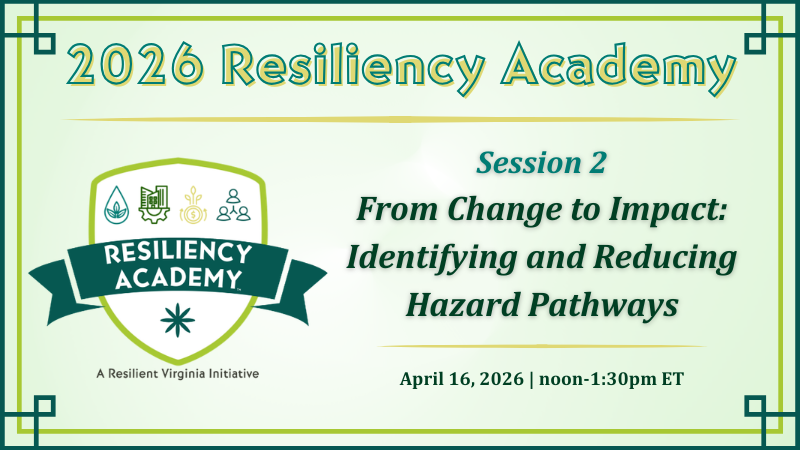
Our Next Event: Thursday, April 16
From Change to Impact: Identifying and Reducing Hazard Pathways
About Our Speaker
Dr. Katie Trozzo
Across Virginia, local governments, businesses, and communities are facing rapidly changing conditions that are reshaping risks, vulnerabilities, and opportunities—particularly across energy systems, environmental conditions, and local economies. These dynamics are placing new demands on decision-makers to act quickly, strategically, and with limited resources.
This session, led by Thomas D. “Tom” Peterson, President and CEO of the Center for Climate Strategies, focuses on practical, proven methods for scoping and prioritizing critical resilience challenges at the local level. Drawing on real-world experience from Virginia and beyond, Tom will present actionable approaches to defining key issues, identifying priority audiences and stakeholders, and designing effective planning and assessment processes.
Participants will gain tools and frameworks to strengthen local capacity, improve public engagement and community problem solving, and develop integrated, multi-sector strategies that respond to today’s evolving energy, environmental, and economic conditions.
The 2026 Resiliency Academy webinar series explores the principles, tools, and strategies needed to understand and strengthen resilience in social, ecological, and community systems. Every session is designed to build sequentially, deepening understanding and skills over the course of the 10-session series.
The second session will focus on expert scoping — an essential process for identifying community hazards and developing practical, forward-looking solutions.
Find Out More About Our Speakers Below
Thomas D. Peterson
President and CEO, Center for Climate Strategies
Thomas D. “Tom” Peterson is President and CEO of the Center for Climate Strategies (CCS), which he founded in 2004 to advance practical, collaborative solutions to climate, energy, and economic challenges. He brings more than four decades of experience in public policy, economic analysis, and stakeholder-driven governance, leading over 100 major policy development and implementation initiatives across the United States and internationally.

Mr. Peterson’s work focuses on building institutional and community capacity to design and implement integrated, multi-objective solutions that address climate resilience, clean energy transitions, economic development, and environmental stewardship. He is widely recognized for his leadership in consensus-based policy processes that translate complex technical analysis into actionable strategies with broad stakeholder support.
In addition to his leadership at CCS, Mr. Peterson serves as Adjunct Professor and Lecturer in the Energy Policy and Climate program at Johns Hopkins University and as Adjunct Professor in the Environmental Science and Policy Department at George Mason University. He also serves as an elected Council Member for the City of Fairfax, Virginia, where he applies his expertise in governance, fiscal policy, and community engagement.
Earlier in his career, Mr. Peterson served as a Senior Advisor at the White House, working with both the Council of Economic Advisers and the Council on Environmental Quality. He has also held roles as a Legislative Fellow in the U.S. Senate, an Economist at the U.S. Environmental Protection Agency, Vice President at DSL Capital Corporation, and Division Chief for a state conservation agency.
He holds a B.S. in Biology from the College of William & Mary, an M.S. in Environmental Management from Duke University, and an M.B.A. from the University of Texas at Austin. His honors include two U.S. EPA Gold Medals for Exceptional Service, recognizing his leadership contributions to the 1992 Northern Spotted Owl Endangered Species Committee and the 1993 Pacific Northwest Forestry Plan.
2026 Resiliency Academy Topics
MARCH
Change Happens: Making Sense of Variability Across the Systems We Depend On
APRIL
From Change to Impact: Identifying and Reducing Hazard Pathways
MAY
Risk and Vulnerability Explained: How Lives, Systems, and Perceptions Shape Outcomes
JUNE
Proactive Resilience: Planning, Adapting, and Mitigating Hazards Before They Strike
JULY
Seeing the Bigger Picture: How Systems Thinking Builds Resilient Communities
AUGUST
Closing the Opportunity Gap: Ensuring Equitable Access to Essential Resources
SEPTEMBER
The Essentials of Change Management: Guiding Communities Toward Resilience
OCTOBER
Understanding Decisions: How Individuals, Organizations, and Political Systems Shape Resilience
NOVEMBER
Building Shared Meaning: Communication Approaches for Multi-Sector Resilience Efforts
DECEMBER
Putting It All Together: Showcasing Resilience in Action
Resiliency Academy Archives
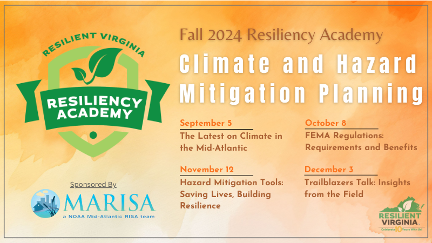
Climate and Hazard Mitigation Planning
SPRING AND FALL 2024
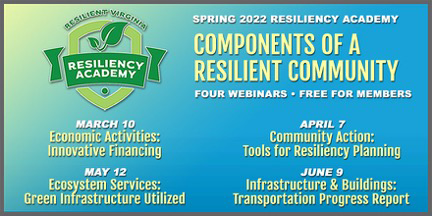
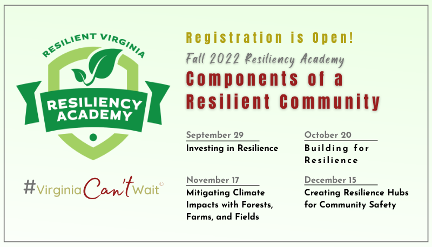
Components of a Resilient Community
SPRING AND FALL 2022
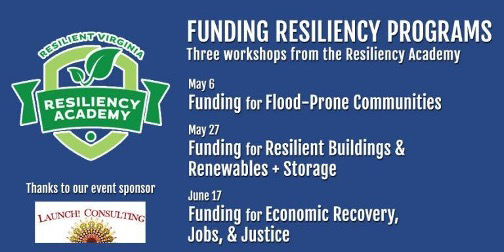
Funding Resiliency Programs
SPRING 2021
Four Resiliency Planning Guides
Fall 2020