On paper, it’s a framework. A set of priorities. A collection of strategies.
But that’s not really what it is.
This roadmap is the result of hundreds of conversations — across kitchen tables, conference rooms, community spaces, and virtual meetings — about what it actually takes to build resilience in a region where challenges don’t show up one at a time.
It Started With a Simple Question
Back in 2023, we kept hearing the same thing from communities across Central and Southwest Virginia:
We know the challenges we’re facing. But we don’t have the capacity, coordination, or resources to tackle them alone.
Flooding wasn’t just a flooding issue — it was tied to infrastructure, land use, and funding. Workforce challenges weren’t just economic — they affected emergency response, long-term planning, and recovery. Extreme heat wasn’t just about weather — it was about health, housing, and access.
Everything was connected. But the systems designed to address these challenges often weren’t.
So the question became: What would it look like to actually connect the dots?
Listening Before Leading
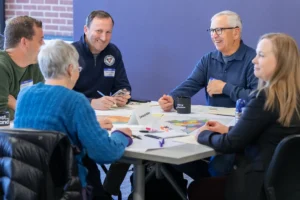
Photo: JMU/Rachel Holderman.
Instead of starting with solutions, we started by listening.
Over the next two years, we worked with more than 100 participants across 11 Planning District Commissions — local governments, community organizations, businesses, researchers, and residents.
People showed up with different perspectives, different priorities, and sometimes very different definitions of what “resilience” even meant.
But there were common threads.
People talked about capacity — how hard it is to move from planning to implementation with limited staff and funding. They talked about trust — how relationships shape what’s possible long before a project begins. They talked about fragmentation — how efforts are often duplicated in one place and missing entirely in another.
And they talked about what’s working.
Because alongside the challenges, there’s something else that defines this region: strong networks, deep local knowledge, and a willingness to show up for one another.
What We Heard Became the Foundation
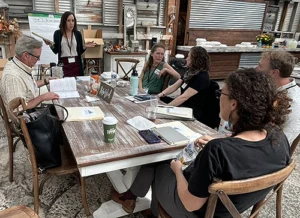
Photo: Resilient Virginia/Trish Porter.
Out of those conversations, four priorities emerged — not because they sounded good on paper, but because they reflected what people are already navigating every day:
Healthy lands and waters
Resilient, sustainable infrastructure
A resilient economy
Informed, connected communities
But priorities alone don’t create change.
What people needed was a way to act on them — together.
Shifting From Projects to Systems
One of the biggest shifts in this work was moving away from thinking in terms of individual projects and toward systems.
Instead of asking, “What’s the next project?” We started asking, “What makes it easier — or harder — for any project to succeed?”
That’s where the six strategies in the Roadmap come in:
Not as standalone ideas, but as the underlying conditions that make resilience possible:
Coordination that reduces duplication instead of creating more of it
Planning that looks ahead instead of reacting after the fact
Shared resources that expand what small communities can do
Trusted spaces — like resilience hubs — that serve people every day, not just during emergencies
Community networks that don’t wait for formal systems to respond
Funding approaches that actually match the scale of the challenges
These aren’t quick fixes. They’re ways of working.
This Is Where the Real Work Begins
It would be easy to think of the Roadmap as the end of a process. In reality, it’s the beginning of a different phase — one that’s messier, more iterative, and more grounded in action.
Because a roadmap doesn’t implement itself.
The next chapter is about supporting communities as they take what’s in this document and make it real — through partnerships, projects, policy changes, and new ways of working together.
That includes building tools like a Regional Resilience Dashboard, providing technical assistance, continuing to convene partners, and helping align funding and resources with the priorities identified in the Roadmap.
Why This Matters
Central and Southwest Virginia needs this roadmap now more than ever. Numerous and evolving threats, including extreme temperatures and precipitation, local government capacity constraints, and economic and workforce challenges, create complex obstacles for the region.
Resilience isn’t built through a single plan or a single investment.
It’s built over time — through relationships, coordination, and the ability to adapt as conditions change.
What this Roadmap offers is something simple, but powerful: a shared starting point.
A way for communities, organizations, and leaders across Central and Southwest Virginia to move in the same direction — even if they take different paths to get there.
And maybe most importantly, it reflects something we heard again and again throughout this process: No one is starting from scratch.
The work is already happening. This just helps connect it.
Please note: This form is not intended for sales or marketing solicitations. Please do not use it for promotional outreach; these submissions will not receive a response.
Have a resilience challenge, project idea, funding opportunity, or capacity need? Tell us a little about what you’re working on and where you could use support.
Stay in the Loop
Please note: This form is not intended for sales or marketing solicitations. Please do not use it for promotional outreach; these submissions will not receive a response.
Get Resilient Virginia news, program updates, learning opportunities, events, resources, and ways to get involved delivered to your inbox.
Explore an Industry Partnership
Please note: This form is not intended for sales or marketing solicitations. Please do not use it for promotional outreach; these submissions will not receive a response.
Start a Strategic Partnership Conversation
Please note: This form is not intended for sales or marketing solicitations. Please do not use it for promotional outreach; these submissions will not receive a response.
Talk With Us About Partnership
Please note: This form is not intended for sales or marketing solicitations. Please do not use it for promotional outreach; these submissions will not receive a response.
Trish Porter
Director of Programs & Communications
Trish Porter is the Director of Programs and Communications at Resilient Virginia, where she develops and leads programs focused on resilience, systems thinking, and cross-sector collaboration. She is the co-creator and curriculum lead for the Resilience Foundations Certificate Program and served as lead author of the Regional Resilience Roadmap for Central and Southwest Virginia.
In her role, Trish oversees statewide educational initiatives including the Resiliency Academy, Spotlight On Webinar series, and the biennial Resilient Virginia Conference. She works closely with local governments, nonprofits, academic institutions, and state agencies to support resilience planning, knowledge sharing, and collaborative problem-solving across sectors.
Trish specializes in translating complex resilience and sustainability concepts into practical, accessible learning experiences for local leaders, practitioners, and communities. She holds a Master of Natural Resources with a Graduate Certificate in Global Sustainability from Virginia Tech and brings a multidisciplinary background in sustainability, communications, education, and strategic program development.
Jessica Steelman
Executive Director
Jessica is a systems-level resilience and sustainability practitioner with experience leading nonprofit strategy, cross-sector partnerships, community-centered planning, and resilience implementation across Virginia. She brings a multidisciplinary background in coastal resilience, behavioral health, community engagement, grant strategy, and organizational leadership, with a focus on strengthening the natural, built, economic, and social systems that communities depend on.
Her work centers on connecting people, resources, and ideas across public, private, nonprofit, academic, and regional networks to move resilience priorities from planning into practical action. Through strategic leadership, program design, partnership development, and resource mobilization, she helps communities and organizations build capacity, reduce risk, and advance more resilient and sustainable futures.
Customized Learning Request
Please note: This form is not intended for sales or marketing solicitations. Please do not use it for promotional outreach; these submissions will not receive a response.
Media Inquiry
Please note: This form is not intended for sales or marketing solicitations. Please do not use it for promotional outreach; these submissions will not receive a response.
For media inquiries, interviews, speaking requests, organizational background, or information related to whole-community resilience in Virginia, connect with our team.
Get Alliance Updates
Please note: This form is not intended for sales or marketing solicitations. Please do not use it for promotional outreach; these submissions will not receive a response.
Stay connected to the Collaborative Alliance and receive updates on upcoming quarterly forums, emerging resilience issues, shared resources, statewide insights, and opportunities to participate in the network.
Join the Dashboard Pilot
Please note: This form is not intended for sales or marketing solicitations. Please do not use it for promotional outreach; these submissions will not receive a response.
Sign up to receive pilot access and opportunities to provide feedback.
Get Conference Updates
Please note: This form is not intended for sales or marketing solicitations. Please do not use it for promotional outreach; these submissions will not receive a response.
Be the first to know when registration opens and receive conference announcements.
NEXT RESILIENCY ACADEMY JUNE 25: Proactive Resilience: Planning, Adapting, and Mitigating Hazards Before They Strike