Economic Development in a Changing Climate: Minimizing Risks and Maximizing Opportunities

Home » Economic Activities » Business Case for Resiliency » Economic Development in a Changing Climate: Minimizing Risks and Maximizing Opportunities

Economic Development in a Changing Climate: Minimizing Risks and Maximizing Opportunities

Home » Economic Activities » Business Case for Resiliency » Economic Development in a Changing Climate: Minimizing Risks and Maximizing Opportunities
EDRP_Economic_Development_in_a_Changing_Climate+(1)

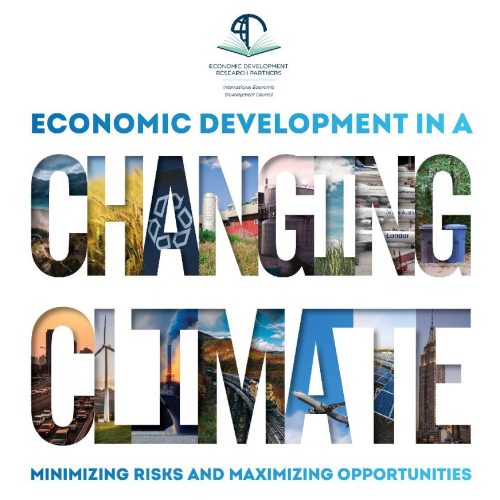
This report, published by the International Economic Development Council, introduces the topic of climate change and its impact on economic development. It suggests that economic development organizations (EDOs) have key roles to play in helping communities mitigate climate related disruptions and in helping businesses take advantage of new opportunities in a low-carbon economy and offers 5 key action they can take to navigate the climate-impacted economy of the future.

1. Understand the physical risks to the region and smaller areas within it, as well as industries, individual businesses and the workforce.

2. Learn about the business and industry trends that will affect existing employers and investment growth and attraction.

3. Get comfortable talking about climate change impacts on the economy.

4. Incorporate climate risks and opportunities into economic development strategic plans.

5. Connect, align and leverage to create partnerships and spur action.

Download the Executive Summary

Download the Full Report

Watch the Recorded Webinar

Become a Member
Become a Sponsor
Become a Volunteer

Sign Up for E-News

Get news and notifications from Resilient Virginia.

The Resilience Calendar

  • Accelerating Climate Progress with AI: From Science to Action Workshop
    Date: January 13, 2026
    Location: Virtual

    The National Academies is organizing a workshop to explore innovative ways AI can enhance climate science and support decision-making for resilience and mitigation. The workshop will identify critical applications where AI can inform climate…

  • RVCA Agriculture Working Group
    Date: January 22, 2026
    Location: Virtual

    Resilient Virginia Collaborative Alliance Agriculture Working Group monthly meeting. Anyone is welcome to join the conversation!

    RVCA Agriculture Working Group
    Thursday, October 23 · 11:00am – 12:00pm
    Time zone: America/New_York

  • NCASC Webinar Series: Incorporating the RAD (Resist-Accept-Direct) Framework into Resource Management Planning
    Date: January 22, 2026
    Location: Virtual

    The National CASC is hosting a quarterly webinar series on the RAD (Resist-Accept-Direct) framework, a tool that helps resource managers make informed choices for responding to change. This series focuses on examples of RAD…

Latest News & Resources

Introducing the Resilience Foundations Certificate: Empowering Practitioners to Build a More Resilient Commonwealth

Virginia is facing growing challenges from sea-level rise, recurrent flooding, extreme heat, and economic disruption—making coordinated resilience planning more essential than ever.
Beginning in 2026, Resilient Virginia will launch the Resilience Foundations Certificate Program, a first-of-its-kind professional development initiative that brings together leaders from government, business, academia, and community organizations to advance systems-level resilience across the Commonwealth.

Read More »

Resilient Virginia News: Fall 2025

The Power of Partnership … Spotlight On Webinar Series … Resilience Certificate Survey … Interactive StoryMaps Advance Climate Equity … RVCA Updates … Tackling Emerging Contaminants Water Technical Assistance … Closing America’s Wastewater Access Gap Initiative … Firewise Virginia Community Hazard Mitigation Grant Program … more.

Read More »

Where Data Meets Story: Mapping Equity in Virginia

VCU RISE has launched interactive StoryMaps to highlight environmental justice issues in Charles City County, Emporia, and Richmond. Learn how these equity-focused tools blend local data, maps, and community stories to support planning, resource access, and climate resilience.

Read More »